

A Beginner's Guide to Investing Without the Jargon
If the word "portfolio" makes you want to close your laptop, this is for you. We strip away the Wall Street fluff to explain how creators can build a financial safety net using nothing but common sense and consistency.
If the word "portfolio" makes you want to close your laptop, this is for you. We strip away the Wall Street fluff to explain how creators can build a financial safety net using nothing but common sense and consistency.

For most of us in the creative world, "investing" feels like a club we aren't invited to. We imagine wood-panneled rooms, shouting men on trading floors, and a language made up entirely of confusing acronyms like ETF, APY, and P/E ratios.
It feels like a math test we didn't study for.
But for the writer, the podcaster, or the independent editor, investing isn't about "beating the market." It’s about Sovereignty. It is the process of turning the money you earn today into the freedom to choose your projects tomorrow.
Here is the "No-Jargon" roadmap to getting started.
The Seed and the Tree
Think of your income as a harvest. Most people eat all their seeds. If you eat all your seeds, you are forever dependent on next year's weather.
Investing is simply the act of planting a few of those seeds in a field you don't touch. At first, it looks like nothing is happening. But over time, those seeds turn into trees, and eventually, the trees produce fruit whether you work that day or not.
The Only Two Terms You Need to Know
While Wall Street loves complexity, there are really only two concepts that matter for a beginner:
- The Snowball Effect: This is the magic of your money making its own money. If you have $\$100$ and it grows by $10\%$, you have $\$110$. Next year, that $10\%$ growth applies to the full $\$110$, not just your original hundred. Over decades, this "snowball" becomes an avalanche.
- The Shopping Cart (Index Funds): Instead of trying to pick the "best" single company (which is like trying to find one perfect strawberry in a giant field), you buy the whole shopping cart. An "Index Fund" is just a basket that holds a tiny piece of every major company. If the world economy grows, your basket grows.
"Investing is the only way to make sure that 'Future You' isn't still hustle-culture's prisoner." — Editorial Note
Isn't it just gambling?
Gambling is a game of chance where the house always wins in the long run. Investing in the broad market is a game of ownership where, historically, the "owners" have won as the world becomes more productive. The "house" in this case is the global economy.
The "Barbell" Strategy for Creators
For those of us with irregular freelance income, the best way to invest is the "Barbell" approach:
- The Heavy End: Keep a solid chunk of cash in a boring savings account for emergencies (The "Feast and Famine" shield).
- The Growth End: Put small, automated amounts into your "Shopping Cart" (Index Funds) every single month, regardless of whether the market is up or down.
Moving From Consumer to Owner
Every time you pay for your Ghost subscription, buy an Apple laptop, or sip a Starbucks latte, you are a consumer. When you invest in those companies (via your "Shopping Cart" fund), you become an owner.
The goal is to slowly tilt the scales so that more of your life is funded by your ownership than your labor.
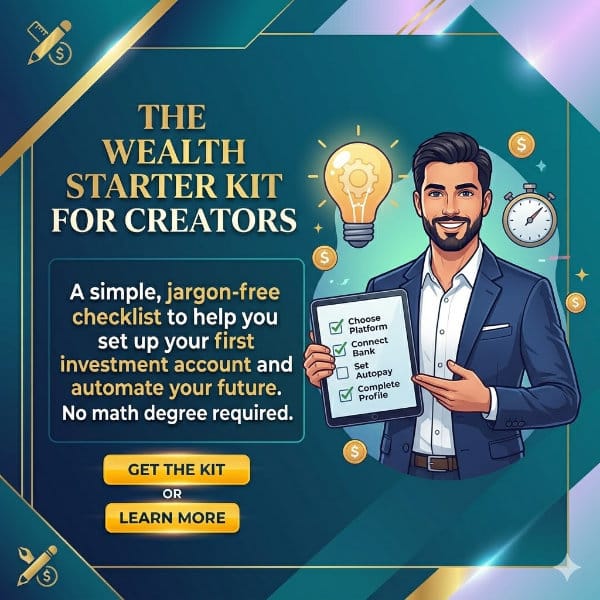
The Wealth Starter Kit for Creators
A simple, jargon-free checklist to help you set up your first investment account and automate your future. No math degree required.
The Best Time to Start
The best time to plant a tree was twenty years ago. The second best time is today. You don't need to be an expert to start; you just need to be a person who decides that a small portion of their current work belongs to their future self.